Showing posts with label Rosh Hashanah. Show all posts

Sep 15, 2015

Feed Your Kid's Body and Soul: High Holiday Books with Food Themes

By Jill Colella

A colleague and friend of mine who is a rabbi and an accomplished cook once likened the Jewish holiday dinner table to the bimah. Many of the components are the same— a raised surface, a gathering of people with a united purpose, and the sharing of (different forms) of sustenance with reverence and ritual. One way to experience Judaism is through its meals, especially those that happen during the fall harvest. For children especially, food is an accessible way of thinking about their wider worlds.

Basic food literacy is a critical foundation for building cooking skills, and appreciating the symbolism of food, like a beautifully braided round challah on the Rosh Hashanah table. As a writer of a Jewish cookbook for children, I was tasked with creating recipes that were basic enough for children to follow but meaningful enough for some deeper connection. This is why basic food literacy—the ability to identify ingredients—is incredibly important for children.

A few years ago during his TED Talk about the state of food for children, British celebrity chef Jamie Oliver screened a clip from his television show Jamie Oliver’s Food Revolution. He was in a school classroom of six year olds in Huntington, West Virginia and had brought along different fresh vegetables. The  kids were unsuccessful in identifying fresh tomatoes!  One would think that any elementary school aged child could easily identify such a common vegetable.  And while adults may be able to identify most vegetables, many are not exactly confident about how to cook them.


We can think of cooking like reading. When you think about the act of reading, it seems difficult—recognize letters and groups of letters as sounds, and then combine those into words, and then understand a string of words as sentences. Yet, we do it, and we ask kids to do it from an early age. Cooking can be the same, and can be discovered through reading. Some of my favorite Kar-Ben books develop reading literacy, food literacy and cultural literacy all at the same time, in the most charming ways.


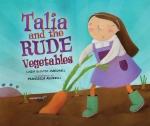
Talia and the Very YUM Kippur and Talia and the Rude Vegetables are clever and funny books that play with words as the title character is helping with preparations for High Holiday meals.


Apple Days tells the story of Katy, who loves making applesauce with her mother. Her enthusiasm will inspire curiosity in any reader. TheApple Tree’s Discovery is another great title for reading during “apple days,” with its message that each of us is a unique individual. The book also reveals a very special feature about apples, which will prompt young eaters to observe the foods they eat more closely.


Maybe the very best example of food literacy materials for children is What’s the Buzz? Honey for a Sweet New Year. The book provides photos of a school trip to an apiary (bee farm) in Israel. Truly a farm-to-fork book, the story will help young readers understand where the honey on the Rosh Hashanah table comes from.

Jill Colella is editor of two magazines about food for children, for readers ages 6-12, Ingredient (www.ingredientmag.com) and for readers ages 3-6, Butternut (www.butternutmag.com). 

Sep 16, 2014

Rosh Hashanah Activities for Home and Classroom!

Rosh Hashanah is just around the corner! It's one of our favorite holidays here at Kar-Ben - there's delicious apples and honey to be eaten, the first chilly feeling of fall in the air, a year to look back on and be thankful for, and a whole new year to look forward to! To help celebrate, we've found some fun and thoughtful Rosh Hashanah activities great for both the home and classroom.

L'shanah tovah!

Apple Blessings Placemat
These adorable and easy placemats are also a great way to remember the blessings for eating the traditional Rosh Hashanah apples and honey. Using halved apples and poster paint to decorate the placemates gives them a special fall feeling, and makes for an affordable classroom activity too! From Kveller.

Apples in short supply? You can use the ends of bottle corks instead! Cutting a small divot out of the cork with make the stamp more apple-shaped, and green marker can be used to add a leaf detail.

Hanging Apple Decorations
These sweet decorations are a great way to reuse plastic bottles. In fact, many part of this craft can be made from extra materials lying around the house, making this a great spur-of-the-moment craft! A great activity for older children, or for younger children with help from an adult. The end result is a beautiful apple decoration that you can even use again at Sukkot! From Joyful Jewish.

3-D Shanah Tovah Card
A great classroom activity for older kids, the end result is a pop-up book-style card to give to family or friends to wish them l'shanah tovah! All that's required is the card template, coloring supplies, glue or tape, and scissors. From Chabad.org.

Stained Glass Fish
This neat craft lets kids create a beautiful stained-glass effects just using materials found at home. This symbol of abundance is a wonderful decoration for the holiday, whether you partake in eating a fish's head or not!

Paper Shofar
These colorful and kid-friendly shofars will make sure that everyone is able to help ring in the new year! The materials are simple and classroom friendly too, making this a great craft for school. From Joyful Jewish.

Edible Honey Bowl
A new and creative touch to add to the traditional apples and honey, this is a craft for a kid to do with a little help and a lot of supervision. From Kveller.

Shofar Word Search
A great way to engage kids in a discussion of the many important and meaningful elements of Rosh Hashanah. From Aish.com.

Papier Mache Apple
This is a more time- and materials-intensive craft, but the payoff is wonderful - a papier mache apple to fill with each child's hopes or plans for the coming year. From How Stuff Works.

Cinnamon-Apple Honey Cake
A twist on the traditional Rosh Hashanah honey cake, this sweet treat is relatively simple and provides lots of places for kids to help out in the kitchen! From Taste of Home.


And, of course, read a good book!
Have you taken a look at Apple Days: A Rosh Hashanah Story yet? It's a wonderful holiday story about Katy, whose favorite holiday is Rosh Hashanah, when she gets to pick apples and make applesauce with her mother. But what happens when the tradition is interrupted by the early arrival of her new baby cousin?

Check out this blog post from author Allison Sarnoff Soffer (you can also watch the book trailer), and use the Activity Guide for more Apple Days-inspired activities and reading questions!

Sep 2, 2014

Apple Days: Behind the Scenes

We're so excited to announce our September Book of the Month, Apple Days: A Rosh Hashanah Story! Apple Days tells the story of Katy, whose favorite holiday is Rosh Hashanah, when she gets to pick apples and make applesauce with her mother. But what happens when the tradition is interrupted by the early arrival of her new baby cousin?

We love this book because it presents a situation to which every kid can relate - when family priorities must sometimes change - and Katy handles the change of plans both realistically and admirably. With a new twist on the traditional apples and honey for Rosh Hashanah, a community that comes together to lend a hand, and a sweet family tradition, there are an abundance of things to love about Apple Days!

Below, check out the book trailer and a guest post from the author, or head over to the Kar-Ben website for an Activity Guide or to get a copy of the book!

Watch the book trailer:


And read a guest post from author Allison Sarnoff Soffer!
 
"I want to share a bit about the story behind the story of Apple Days.

For years I’ve cherished a random collection of impressions about apples that have somehow felt connected.   As a child, I remember watching my father peel a Granny Smith apple with his Swiss army knife, removing one very long coil of light green skin. The gently spiced scent of my mother’s apple crisp baking for company also stays with me.  Later, when I became a parent, I savored my family’s experience of apple-picking at a local orchard and returning home to make applesauce for Rosh Hashanah.  Suggested by a friend, this outdoor respite from the busyness of September was to become an annual tradition.

I found myself jotting down apple ideas that I read or heard about.  A short essay about a child watching grown-up hands slicing apples evoked strong identification.  The image of a wedding tradition where guests presented apples to the bride’s parents also impressed me.   Then to my delight, I received an assignment to bring our favorite fruit to a family retreat to contribute to a community fruit salad. Of course, we brought apples!

When we broke into groups at the retreat, I had the chance to describe our family’s apple-picking tradition. I realized that I had never before articulated it.  There was more to understanding the meaning of our trips to the orchard, which grew out of a poignant need, I explained.  Because I lost my mother as a young woman, I had to find a way to be able to celebrate with my young children, to protect them from my sense of loss as the High Holy Days approached.  Getting outside, instead of preparing entirely in the kitchen, became my unexpected answer.  One group member was listening carefully: children’s author and rabbi Mindy Portnoy.   

At this point in my life, I was a new teacher at Temple Sinai Nursery School where I would eventually set the story. A significant development at school inspired the story’s turning point. A beloved teacher was ill and the community galvanized to help.  Children, watching their parents and teachers acting on their kindest instincts, wanted to join the effort. They initiated their own baking efforts culminating in a series of sales that raised almost $5,000 over several months.

I let my mind work on these varied impressions as I always do when I am deep in a writing process.  As Rabbi Portnoy and I met to discuss ideas, the arc of the story slowly came together. Of course, it was going to be a book about apples. Its premise would be the anticipation of our family’s beloved apple-picking ritual by a mother and a daughter. It would focus on disappointment overcome in an unexpected way, the power of community, and the competence of children. 

Apple Days took about a year to write, through two Rosh Hashanahs, and many revisions. When it was done, it felt more complete than anything that I had ever written.  To me, this story was crying out to be told, to get off of my computer screen and into the world. 

I hope that children will listen to Apple Days during a teachable moment with their parents or teachers, when they can pause and really hear it.  Perhaps it will inspire them to welcome the Jewish New Year at a local orchard or to try a new apple recipe.  Maybe Apple Days will spark an idea for a completely novel holiday tradition, or encourage a child to help a struggling friend.  You just never know what can happen.  This is my hope for Apple Days."

Sep 17, 2013

Thinking of Engineer Ari in Jerusalem

Kar-Ben friend and Engineer Ari fan Kathe recently wrote us about the newly renovated Jerusalem train station. She said it made her think of the Engineer Ari books, and it certainly reminded us of them as well!


The History
On August 27, 1892, the first train steamed into Jerusalem from Jaffa, carrying passengers and cargo. A month later, during the High Holidays, the railway officially opened. The train shortened the trip between the Mediterranean coast and Jerusalem from 3 days to 3 1/2 hours. Eliezer Ben-Yehuda, the father of modern Hebrew, who lived in Jerusalem at the time, coined the word rakevet (train) from the Biblical word for "chariot."

The railway began as a modest operation with three train built by the Baldwin Locomotive Works of Philadelphia. It was rumored that the trains were originally intended for the first Panama Canal project. When this project failed, the trains were shipped to Jaffa instead. The railway was 55 miles long, made 6 stops between Jaffa and Jerusalem, and rose nearly 2500 feet as it curved up through the Judean mountains.

In 1998, the Jerusalem-Jaffa railway and the Jerusalem Railway Station were closed, and the station lay neglected for many years.


In May 2013, however, the Jerusalem train station was newly renovated, incorporating modern shops, restaurants, and other attractions into the historic site, making the old station into a hub of activity as a cultural and entertainment center.

Engineer Ari
Enigineer Ari has had many different adventures on the railway, but Enigneer Ari and the Rosh Hashanah Ride highlights a particular moment in history - the opening of the railway from Jaffa to Jerusalem - and this particular train station.

In Engineer Ari and the Rosh Hashanah Ride, Engineer Ari has been chosen to drive the very first train from Jaffa to Jerusalem - what an honor! But after boasting to his fellow engineers, he forgets to say good-bye. As he journeys up and down the hills wishing everyone a Happy New Year, he remembers that Rosh Hashanah is a time for turning around and saying you're sorry.

Other Engineer Ari titles include Engineer Ari and the Hanukkah Mishap and Engineer Ari and the Sukkah Express, available at www.karben.com.

Thank you for the photos, Kathe!

Aug 27, 2013

A Guest Post from "What a Way to Start a New Year!" Author Jacqueline Jules


Beginning the New Year in a new city isn't easy, and it definitely isn't starting out very well for Dina and her family! But when they're welcomed by warm and generous hosts in their new community it becomes a very happy New Year for all!


In today's guest blog post, author Jacqueline Jules tells us a little bit about the inspiration for her new Rosh Hashanah book, What a Way to Start a New Year!:


"I grew up in a small town in southern Virginia. There was only one synagogue in the surrounding area with a community of around 100 families. New faces didn’t walk through the door without being noticed, especially by my father. He made a point of introducing himself and making sure any newcomers had plans for holiday dinner. When Daddy brought new friends home unexpectedly, Momma would smile and set an extra place. My mom was an excellent cook, known for her homemade apple pies and tender brisket. We made many wonderful new friends at our holiday table.

As a child, watching my parents observe the mitzvah of hachnasat orchim—welcoming guests—I never imagined that I would one day move to a new community at the High Holidays myself. My first Rosh Hashanah as a newlywed was spent with generous hosts in Pittsburgh who realized a young couple would prefer brisket and honey cake in a warm home, rather than a motel efficiency. In my adult life, I have moved several times to new cities. Each time, visiting a synagogue, where I heard familiar tunes and prayers, helped me to adjust to new surroundings.  

In What a Way to Start a New Year, Dina and Harry fear that moving will ruin their Rosh Hashanah holiday. They want to go back to Greenville. “In Greenville we had friends,” Dina says. “In Greenville we didn’t get lost on the way to the grocery store.” But their plans are ruined by car troubles and the family returns to packing boxes and leftover pizza. “No brisket? No honey cake?” the kids complain. “What a way to start a new year!” Happily, Dad suggests that the family attends services at a nearby synagogue, where new friends welcome them just as my parents welcomed newcomers many years ago." 
 
For a sneak peak at What a Way to Start a New Year! check out the book trailer!
 
Q & A with Jacqueline Jules
 
What was your favorite book when you were a child?
 
My favorite book was The Borrowers by Mary Norton. I adored the idea of little people under the floorboards swiping all the things I could never find. I still think there must be little people in my house, borrowing all the items I can't locate when I need them.
 
What's your favorite line from a book?
 
"Maybe, if you aren't unhappy sometimes, you don't know how to be happy." - from A Wrinkle in Time by Madeline L'Engle
 
Why did you want to become an author?
 
I became an author because I love to play with words. Words give us the means to communicate with others. We speak them, we write them, and we read them. My love of words began with my love of reading. As a child, I sat for hours - sometimes in the crook of an apple tree, sometimes in an easy chair - lost in absorbing mysteries, fantasies, biographies, and realistic or historical fiction. I didn't have much preference, and still don't for a particular genre. I am just an enthusiastic fan of a good story with compelling characters.
 
Do you have any advice for future authors?
 
Remember that it takes a very long time to become skilled at any art form. Malcolm Gladwell in his book Outliers says it takes about 10,000 hours of practice to excel at something. I totally agree. I've been practicing my craft for over 30 years, and it still takes many revisions before I get a story right. Writing is hard work. You need to have the patience and persistence to write and re-write.
 
How do you hope your book will impact the Jewish life of a child?
 
I hope children will empathize with the difficulties of feeling comfortable in a new place. I hope it will motivate them to reach out to newcomers.
 
What are some fun facts about you?
 
I love the color purple. My bedroom, my winter coat, and too many of my clothes and earring are purple. I also love puppets and have a huge collection of them. I love to sing for fun, especially at story time.
 
Anything else you would like to share with readers?
 
READ! READ! READ! Nothing expends your world and your mind like reading.
 
 
Jacqueline Jules is an award-winning author and poet. Her many children's books include The Hardest Word (National Jewish Book Award finalist), Sydney Taylor Honor Award Winners Sarah Laughs and Benjamin and the Silver Goblet, the Ziz adventure series, and Once Upon a Shabbos. She lives in Northern Virginia with her husband and enjoys walking, reading, singing, and attending the theater. To learn more about her, please visit www.jacquelinejules.com.


Aug 28, 2012

Have a Sweet New Year with Honey Fun Facts


  • It is a tradition on Rosh Hashanah, the Jewish New Year, to eat apples or challah dipped in honey as a wish for a sweet new year.
  • In the Torah, Israel is called “the land of milk and honey,” because its climate is ideal for grazing animals and growing flowers.
  • People have collected honey from bees since prehistoric times. In Tel Rehov archeologists found clay beehives which are over 3000 years old!
  • In Israel today, there are more than 90,000 beehives in over 6,000 locations around the country. Most of the honey they produce is sold at Rosh Hashanah time.
  • To make one pound (half a kilogram) of honey, bees must collect nectar from two million flowers.

Excerpted from What's The Buzz? Honey for a Sweet New Year by Allison Ofanansky and photographed by Eliyahu Alpern.

Visit a bee farm, and follow the bees, as they carry “kisses” from flower to flower, and return to their hives with their tummies full of nectar. Learn how the honey is extracted from the combs and makes its way from the hive to the table, to be enjoyed with slices of apples for a Rosh Hashanah treat.

Oct 6, 2011

Tolerance, Torah and Tears in Tennessee

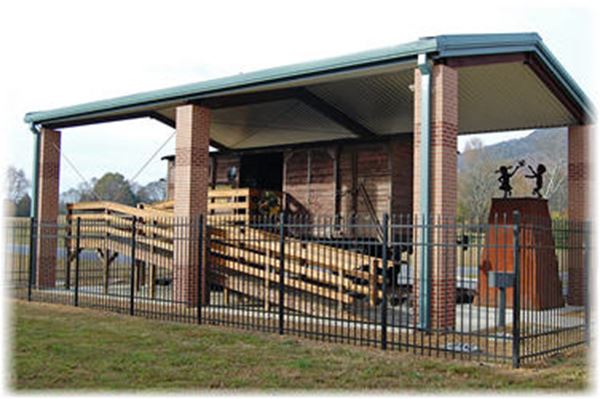
Beth Huppin, a Judaics teacher from Seattle and recent recipient of the National Covenant Award, shares an account of her unusual Rosh Hashanah experience this year. Traveling with her husband, Huppin, who generally attends Shul on the second day of Rosh Hashanah, agreed “with some ambivalence” to visit Whitwell Middle School in rural Tennessee instead. This school, famous for creating a monument to Holocaust victims of Nazi Germany using paper clips as a means for understanding the staggering number of victims, became the subject of the documentary film Paper Clips and the Kar-Ben book Six Million Paper Clips. Huppin’s husband, also an educator, has taught about the Whitwell program in his classes and wanted to visit.

The project, begun about ten years ago, was started by now retired principal Linda Hooper, who remains involved. The school continues to train student docents to give tours to the public, archives letters that continue to arrive “from every corner of the world,” and collects artifacts for the project’s resource room. The day Huppin visited, a class of African-American students from Chattanooga also arrived, learning about the Holocaust from the young white Christian docents -- on Rosh Hashanah.

Two artifacts, in particular, caught Huppin’s attention: a Torah and an Aron Kodesh (a Holy Ark), in a place in America where most people have never met a Jewish person. She writes:

With tears in my eyes I explained to Linda that this was my first Rosh HaShanah not in synagogue. I told her that my friend, Shelly, had reminded me that there is more than one way to worship. Entering this room and seeing the Torah, I was overwhelmed. Being a religious person herself, I could see that Linda understood. God sees and hears prayers in many different forms, she assured me.
Curious students asked to see the Torah, and Huppin and her husband retrieved their tallitot from their car and carefully unrolled the Torah. Huppin chanted from the beginning of Numbers in Hebrew, and the mainly religious (Christian) student body knew there was common ground. After her reading, Huppin relates:

A girl came up to me after the students left, in tears, so moved to have experienced a Torah reading on Rosh Hashanah. It wasn’t the right Torah reading. (I had considered rolling the Torah to the Akedah, but there wasn’t time.) And there wasn’t a minyan. And we hadn’t recited the requiredt prayers. But, as Shelly told me, worship comes in many forms. And we had just experienced it.
I told Linda that this experience would not have been the same if it hadn’t been Rosh Hashanah. “Well then, it must be beshert,” she (a woman who had lived her whole life in rural Tennessee) said with a grin, using the Yiddish word that loosely translated means “fate.”  Of course.
Beshert indeed.

Sep 28, 2011

Be Rude at Rosh Hashanah

In a recent essay in the Albany Times Union, Kar-Ben author Linda Elovitz Marshall writes about the power of words and their ability to create conflict or bring understanding. Marshall’s most recent book Talia and the Rude Vegetables, plays with language as the young protagonist mishears her grandmother ask her to gather root vegetables from the garden for a Rosh Hashanah stew. Marshall writes:

As she digs for the seven vegetables her grandmother requested, Talia ponders what makes a vegetable rude. Does it talk back to its mother and father? Does it push its brothers and sisters around? Talia remembers that she, too, has been rude and that the Jewish holiday of Rosh Hashanah is coming.
Rosh Hashanah is coming, Talia says, I must ask their forgiveness.
As a child, Talia sees clearly what we, adults, often miss. Talia knows she has been wrong and must ask forgiveness. Rosh Hashanah is coming.
As Marshall continues to connect words and deeds in her piece, she emphasizes forgiveness during the Days of Awe, writing: “One might wonder if that is what happened with the children of Abraham. One might wonder if Hagar and Sarah had spoken kindly to each other, cuddled each other's offspring, perhaps there would be more happiness in the world.” Indeed, the connections between thoughts, words and actions is apparent at Rosh Hashanah and Yom Kippur, and Marshall’s assertion that through awareness of rudeness we can arrive at forgiveness is a compelling one.

Read the whole piece.

Sep 13, 2011

Linda Elovitz Marshall Cooks Up a Rosh Hashanah Story

Finding inspiration for stories is almost always an interesting process. Linda Elovitz Marshall’s new book Talia and the Rude Vegetables has inspirations that are as varied as they are interesting. We interviewed Linda to learn more:
Why did you want to become an author or illustrator?
I love words and I love playing with words. I like to string them together in all sorts of different ways and see what happens. I never get tired of this game. I guess that’s why I like writing.
Where did you get the inspiration for Talia and the Rude Vegetables?
One of the things I enjoy doing is helping people from other countries learn to speak English. While I was teaching a Russian speaker, I realized that there’s not much difference between the sounds of the words “root” and “rude.” I combined this with a recipe that I use for Rosh Hashanah (based on root vegetables, many of which I used to grow in my garden). And that’s how I cooked up the story! I used the name “Talia” because my granddaughter, Talia, was born just about the same time I presented the story to my editor at Kar-Ben.


What is the most interesting thing you learned in the process of writing or illustrating your book?
In an early version, Talia sold the perfect vegetables and gave the money to her grandmother. When I showed that version to my Russian student, she said, “Nyet! Money is not to be in a story for children.” I thought about what she said. And I thought about Tzedakah. That’s how I got the idea that Talia should give the perfect vegetables to the rabbi, for distribution to the poor.

How do you hope your book will impact the Jewish life of a child?
I hope the book will help Jewish children appreciate the joys of gardening and the need to help the hungry.
Get ideas for Rosh Hashanah related activities: grow your own "rude" vegetable.

Sep 9, 2011

Buzzworthy: Interview with Allison Ofanansky

What does author Allison Ofanansky have in common with one of her favorite authors, A.A. Milne?

Both of them write about honey, Milne with his honey eating bear and Ofanansky with What’s the Buzz? Honey for a Sweet New Year. This new book uses words and photography to introduce kids to the process of making honey on an Israeli honey farm. We asked Ofanansky to tell us more about her writing and new book:

Why did you want to become an author or illustrator?
Because I love to read so much I wanted to create books for others, and because I want to share my experiences of living in Israel and interacting with nature.
What are you most excited about promoting in your new book?
I am excited about including so many of my daughters' friends in the next book. I have also enjoyed meeting the people at Dovrat Hatavor and seeing the interesting and engaging way they teach kids about bees and honey.

How do you hope your book will impact the Jewish life of a child?
 I hope that all the books in this series will show the connection between the Jewish holidays and nature, especially the way the seasons in Israel correspond to the different holidays. I also hope to show children a bit about how things can be made or done or found on their own—that not everything has to be bought in a store.

What are some fun facts about you?
I used to go on very long bike trips in the mountains, sometimes lasting weeks or even months. Now I enjoy gardening and hiking around near where I live in the Galilee.

Aug 25, 2011

One Potato, Two Potato, Sweet Potato, Rude Potato

As fall nears, I am bringing some plants indoors for the winter and making mental plans for next year’s garden. Indoor plants help shorten the bleak Minnesota winter, and my new project is growing Sweet Potato Vine.

This is an excellent project for kids. The supplies are cheap—sweet potatoes (ask your grocery store for a “sprouted” bag and you might even score them free), toothpicks, glass jars and water, and the steps are simple:

·         cut a sweet potato in half

·          push toothpicks around its middle

·         suspend it over a jar filled with water (cut-side down) and wait

·         in a few days, you’ll see sprouts (change your water every week or so)

·         eventually, you’ll get bright chartreuse and purplish leaves


Along with reading the new book Talia and the Rude Vegetables, growing a sweet potato vine is an excellent Rosh Hashanah project. Just like the book’s protagonist, kids will learn what a root (not rude!) vegetable is, and get a little experience growing something themselves. Build anticipation for Rosh Hashanah by checking the plant’s growth every day. Try sampling some sweet potatoes and talking about how they are the perfect choice for a sweet new year.

Aug 11, 2011

Teachers: Plan Ahead for Rosh Hashanah Events

In What’s the Buzz: Honey for a Sweet New Year, learn how the honey is extracted from the combs and makes its way from the hive to the table, to be enjoyed with slices of apples for a Rosh Hashanah treat from the perspective of a young Israeli girl on a class field trip.


Unique Rosh Hashanah program ideas for your school: This book offers cross-curricular tie-ins with science, including: studying insects such as bees, the recent threat to the bee population (called colony collapse disorder) as well as the benefits of symbiosis. Students can visit a bee farm or schools can invite a beekeeper to speak to an assembly.
This book is the third in Kar-Ben’s “Nature in Israel” series, and can be part of student learning about Israel, including its terrain and habitat and why it is called the land of milk and honey!

Aug 31, 2010

A Family's Tashlich Ritual as Told in a Picture Book

Shanah Tovah from Kar-Ben! We sat down with Susan Schnur, the co-author of Tashlich at Turtle Rock, a new book for Rosh Hashanah. She wrote the book with her daughter, Anna Schnur-Fishman, based on their own family's Tashlich ritual. We hope you enjoy the book and are inspired to add a nature walk to your Rosh Hashanah celebration!

Where did you get the inspiration for Tashlich at Turtle Rock?
It comes straight from the spiritual Jewish stuff that my husband and I and our two kids do at home. In fact, the names of the two kids in the book are just the real names of my kids -- Lincoln and Anna.

What are you most excited about promoting in your new book?
The idea that you can do cool Jewish stuff outdoors with your own family!

What is the most interesting thing you learned in the process of writing your book?
That it's really fun to write with another human being. I liked writing with my daughter when she was in a good mood, but, for some reason, I also really enjoyed writing with her when she was cranky. I think because I understood that her crankiness had something to do with those moments in the creative process when you're sure that everything you're putting on paper is wrong. It was also cool to write with someone whose literary voice you often trust more than your own.

How do you hope your book will impact the Jewish life of a child?
If a family starts having the confidence to create Jewish rituals of their own at home, out-of-doors, that's very hopeful for Judaism.

What was your favorite book when you were a child?
The Harold and the Purple Crayon series.

What’s your favorite line from a book?
The last lines from Charlotte's Web: "Wilbur never forgot Charlotte. She was in a class by herself. It is not often that someone comes along who is a true friend and a good writer. Charlotte was both."

Who are your top three favorite authors or illustrators?
For children's book authors, I love Daniel Pinkwater. For grownup book authors, I love Rilke. My fave children's book illustrator is N.C. Wyeth.

Why did you want to become an author or illustrator?
I've written since I was 6 years old. Though I went to seminary and then got a doctorate in psychology, in the heartiest part of my hearty-heart-heart, I have always been, and remain, a writer.

Do you have any advice for future authors or illustrators?
To write children's literature, you should start by being a child.

Sep 16, 2009

Happy New Year 5770

To all our authors and illustrators, customers and friends around the world, best wishes for a sweet, happy, healthy and peaceful new year. In Minnesota the leaves have begun to turn. When we build our sukkah in two weeks, it will have cornstalks on the roof. We buy our cornstalks from a local farmer who comes to the farmer's market every year with his load of cornstalks, gourds and other sukkah-friendly material. The trouble was that he could never quite figure out why when he shlepped a few cornstalks one week he would have customers wanting to by dozens, so he'd then bring dozens the next week and nobody would want any.

The year he mentioned this to me, I explained to him that there was indeed a method to the madness, and I gave him a little Kar-Ben Mini Jewish Calendar and circled the following year's pre-Sukkot weekend so he'd know exactly which weekend the Jews would be wanting their cornstalks -- that weekend and no other. I also invited him to our sukkah party so he could see what-the-heck (his words) we were using all those cornstalks for.

And so a friendship was born. He comes to our sukkah party every year bringing gifts of honey or eggs or broomcorn from his farm, and we provide him with a mini calendar every year so he knows when Sukkot is. So now my plug for Kar-Ben calendars -- buy them and give them to your non-Jewish neighbors, teachers and others. They're great, they promote cultural understanding, and you may make a new friend.

Shanah tovah!

Aug 27, 2009

Write What You Don't Know

We asked Jacqueline Dembar Greene, author of the new book The Secret Shofar of Barcelona, to be our first guest blogger. For her new book, Jackie researched about the conversos (secret Jews) in Spain during the time of the Inquisition. Welcome to the Kar-Ben Blog, Jackie!

When I was in grade school, teachers always advised students to “Write what you know.” But what interested me the most was what I didn’t know. The books I most enjoyed reading were about past times and unfamiliar places. That was what I wanted to write about. I thought I’d never be a good writer, though, since nothing interesting had ever happened to me.

It took a job as a news reporter and a personal interest in researching my family’s Sephardic background before I discovered that I could learn about anything—through books, archives, museums, pictures, and experts—and then I truly could write about what I knew. More importantly, I could go on to create a fictional world that was true to history, and draw a reader into that world until they, too, felt they knew it.
Reading historical records sparks most of my book ideas. My historical novels are set in such disparate times and places as Colonial Massachusetts, New Amsterdam in 1654, and Rembrandt’s home in the Jewish Quarter of Amsterdam. My picture books are set in Spain during the 1100s, or places like Ukraine in the 1800s when the Jewish folk character Herschel tricked and teased his neighbors.

So it was with great anticipation that I agreed to research a story about the secret Jews of Barcelona that was mentioned in several Rosh Hashanah sermons a few years ago. The editors at Kar-Ben related the basic tale of a converso named Don Fernando Aguilar who was said to have been the conductor of the Royal Orchestra of Barcelona. Supposedly, he had played the shofar during a concert, right under the noses of members of the dreaded Inquisition.

I began sleuthing the origins of the story. I tried Internet searches, worked with research librarians, and read books on Spanish history, early Spanish music, and life under the Inquisition. I pored through Sephardic and Spanish folk tales, but there was no story of Don Fernando and his shofar.
During a trip to Barcelona, I spoke with members of the historic synagogue tucked into an isolated corner of the old Jewish Quarter. No one there had heard of the story of Don Fernando, but they were excited about it. One member said she hoped that if I wrote the story, a bit of Barcelona’s Sephardic past would be brought to light. I wandered the narrow roads and alleys rummaging through used bookstores, but found nothing to support any historical basis to the tale. Clearly, there was no Don Fernando, no Royal Orchestra of Barcelona, and not a single historical record of the tale.

Far from being discouraged, however, I relished the idea that I could use some elements of the legend while creating my own original twist. Because I planned to write a picture book for children, I wanted a young character to become the story’s hero. Before I sat down to write a word, I decided that my fictional Don Fernando would have a son, Rafael, and he would be determined to sound the shofar on Rosh Hashanah.

The next element I needed was an intriguing way for Don Fernando and Rafael to include the shofar in the community’s secret observance of the holiday. As I read about life in the middle and late 1500s, I learned that Spanish explorers had established a strong foothold in Mexico (New Spain). They converted the native people to Christianity and introduced them to European music. They encouraged the people to play liturgical music on their folk instruments. An eclectic mix of native and European instruments created music for the church.

I also read that whenever there was the slightest excuse, from the birth of a noble child to the celebration of a new saint, the Spanish nobility planned a festival. People traveled long distances on foot, by mule, or wagon. They camped in the fields, set up markets, and sang and danced long into the night. When the festival day arrived, music was a major part of the celebration. Most noblemen kept small musical groups in their employ, and they offered public concerts. They attended dressed in their finery, and peasants were allowed to stand in the back and listen. Often the concerts concluded with celebratory fireworks.

I incorporated these historical facts of life in early Barcelona to write the tale. In my version, Don Fernando composes a musical piece celebrating native instruments from the New World. He chooses a performance date that secretly coincides with Rosh Hashanah, and the Duke unwittingly declares a festival day.

Don Fernando’s son, Rafael, vows to learn to play the shofar that his father has hidden away, and to sound it during the concert so that all the secret Jews can hear it for the first time. He hopes the Duke and his entourage will think the ram’s horn is just another strange folk instrument. Rafael rises above his own fears and bravely sounds the shofar right under the noses of the nobility and members of the dreaded Inquisition.

Writing the story brought memories of the ancient streets of Barcelona back to my mind. It conjured up images of the secret Jews who once lived behind the heavy wooden doors in fear of having their religious beliefs discovered by the Inquisition. It made me feel closer to my Spanish ancestors who probably had been expelled from their homes before they ever heard the shofar’s call. And it made me hope that perhaps, through my fictional story, I might introduce a young reader to a piece of Jewish history from a world they never knew about before—all through the pages of an imaginative story.
Illustrations by Doug Chayka