Showing posts with label Linda Elovitz Marshall. Show all posts

Oct 9, 2012

Abracadabra! A Magical Jewish Connection


In Kar-Ben’s The Mitzvah Magician by Linda Elovitz Marshall, Gabriel the Great learns the power of mitzvoth through magic. While there might only be one Mitzvah Magician, many Jewish magicians have been part of the world of magic for quite some time.

Perhaps the most famous magician of all time, Harry Houdini, was born in Budapest as Erik Weisz, the son of Rabbi Mayer Samuel Weisz and Cecelia Weisz. When Harry was four, his family moved to Appleton, Wisconsin where his father led a Zion Reform Jewish Congregation in worship for nine years. Harry and his family then moved to New York City, where Harry began to cultivate and develop his skills as a magician. As a noted escape artist, Harry was world renown for his ability to escape any sort of obstacle or restraint. He died in 1926 and is buried in Machpelah Cemetery, a Jewish cemetery in Queens, New York.
If we then fast forward 30 years, almost to the exact day, illusionist David Seth Kotkin was born. Arguably, the most famous magician in the world, you might know him by his stage name, David Copperfield. Copperfield was born in Metuchen, New Jersey to Jewish parents Hyman and Rebecca Kotkin. Copperfield is known for his way of combining storytelling with illusion, earning him an astounding 21 Emmy awards!

What’s more? The famous adage “abracadabra” is of Jewish origin! The saying comes from Aramaic, the lingua franca of the Jews during the Second Temple Period (539 BCE - 70CE) and the main language in the Talmud. Similar to Hebrew, the word abra (אברא) in Aramaic means “I have created,” and the word cadabra (כדברא) means “by my speech.” Hence its use by magicians is meant to showcase their ability to create simply through their words.
-Max Edwards

Jun 19, 2012

Stories Inspired By Real-Life Objects

We've got heavy rain, soaked ground and high humidity here in Minnesota. It is not a day to go outside and play. I imagine kids will be lurking around the house looking for something to do. Create a story challenge. Ask your child to write a story (or if they are too young, to draw you a story) inspired by an object in your home. Teach creative thinking by asking your child to carefully observe each room and its contents and to select three possible items. Then discuss the possibilities of each and help the child be enthusiastic about one item. Then, set them to work at the kitchen table or desk with paper and pencils and wait for genius to arrive. Inside the imagination is a great place to play.

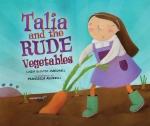
Need a bit of inspiration? Grandma Rose's Magic, the latest book by Linda Elovitz Marshall (who also wrote the charming Talia and the Rude Vegetables and has another book, The Mitzvah Magician, forthcoming this fall) is inspired by a real-life object.


The story focuses on Grandma Rose, a skilled seamstress. She creates garments and goods for her customers, and saves the money she earns to purchase dishes she admires in the big downtown department store. But, when she has earned enough, the dishes are gone! To her surprise, she does receive the beautiful dishes that look just like the ones her grandma had, but not in the way she expected!

Grandma Rose's Magic is special, but even more so when you know it is inspired by a real set of dishes. Here is a picture, courtesy of the author!


What object would you write a story about?

Sep 28, 2011

Be Rude at Rosh Hashanah

In a recent essay in the Albany Times Union, Kar-Ben author Linda Elovitz Marshall writes about the power of words and their ability to create conflict or bring understanding. Marshall’s most recent book Talia and the Rude Vegetables, plays with language as the young protagonist mishears her grandmother ask her to gather root vegetables from the garden for a Rosh Hashanah stew. Marshall writes:

As she digs for the seven vegetables her grandmother requested, Talia ponders what makes a vegetable rude. Does it talk back to its mother and father? Does it push its brothers and sisters around? Talia remembers that she, too, has been rude and that the Jewish holiday of Rosh Hashanah is coming.
Rosh Hashanah is coming, Talia says, I must ask their forgiveness.
As a child, Talia sees clearly what we, adults, often miss. Talia knows she has been wrong and must ask forgiveness. Rosh Hashanah is coming.
As Marshall continues to connect words and deeds in her piece, she emphasizes forgiveness during the Days of Awe, writing: “One might wonder if that is what happened with the children of Abraham. One might wonder if Hagar and Sarah had spoken kindly to each other, cuddled each other's offspring, perhaps there would be more happiness in the world.” Indeed, the connections between thoughts, words and actions is apparent at Rosh Hashanah and Yom Kippur, and Marshall’s assertion that through awareness of rudeness we can arrive at forgiveness is a compelling one.

Read the whole piece.

Sep 13, 2011

Linda Elovitz Marshall Cooks Up a Rosh Hashanah Story

Finding inspiration for stories is almost always an interesting process. Linda Elovitz Marshall’s new book Talia and the Rude Vegetables has inspirations that are as varied as they are interesting. We interviewed Linda to learn more:
Why did you want to become an author or illustrator?
I love words and I love playing with words. I like to string them together in all sorts of different ways and see what happens. I never get tired of this game. I guess that’s why I like writing.
Where did you get the inspiration for Talia and the Rude Vegetables?
One of the things I enjoy doing is helping people from other countries learn to speak English. While I was teaching a Russian speaker, I realized that there’s not much difference between the sounds of the words “root” and “rude.” I combined this with a recipe that I use for Rosh Hashanah (based on root vegetables, many of which I used to grow in my garden). And that’s how I cooked up the story! I used the name “Talia” because my granddaughter, Talia, was born just about the same time I presented the story to my editor at Kar-Ben.


What is the most interesting thing you learned in the process of writing or illustrating your book?
In an early version, Talia sold the perfect vegetables and gave the money to her grandmother. When I showed that version to my Russian student, she said, “Nyet! Money is not to be in a story for children.” I thought about what she said. And I thought about Tzedakah. That’s how I got the idea that Talia should give the perfect vegetables to the rabbi, for distribution to the poor.

How do you hope your book will impact the Jewish life of a child?
I hope the book will help Jewish children appreciate the joys of gardening and the need to help the hungry.
Get ideas for Rosh Hashanah related activities: grow your own "rude" vegetable.