Showing posts with label Talia and the Rude Vegetables. Show all posts

Sep 15, 2015

Feed Your Kid's Body and Soul: High Holiday Books with Food Themes

By Jill Colella

A colleague and friend of mine who is a rabbi and an accomplished cook once likened the Jewish holiday dinner table to the bimah. Many of the components are the same— a raised surface, a gathering of people with a united purpose, and the sharing of (different forms) of sustenance with reverence and ritual. One way to experience Judaism is through its meals, especially those that happen during the fall harvest. For children especially, food is an accessible way of thinking about their wider worlds.

Basic food literacy is a critical foundation for building cooking skills, and appreciating the symbolism of food, like a beautifully braided round challah on the Rosh Hashanah table. As a writer of a Jewish cookbook for children, I was tasked with creating recipes that were basic enough for children to follow but meaningful enough for some deeper connection. This is why basic food literacy—the ability to identify ingredients—is incredibly important for children.

A few years ago during his TED Talk about the state of food for children, British celebrity chef Jamie Oliver screened a clip from his television show Jamie Oliver’s Food Revolution. He was in a school classroom of six year olds in Huntington, West Virginia and had brought along different fresh vegetables. The  kids were unsuccessful in identifying fresh tomatoes!  One would think that any elementary school aged child could easily identify such a common vegetable.  And while adults may be able to identify most vegetables, many are not exactly confident about how to cook them.


We can think of cooking like reading. When you think about the act of reading, it seems difficult—recognize letters and groups of letters as sounds, and then combine those into words, and then understand a string of words as sentences. Yet, we do it, and we ask kids to do it from an early age. Cooking can be the same, and can be discovered through reading. Some of my favorite Kar-Ben books develop reading literacy, food literacy and cultural literacy all at the same time, in the most charming ways.


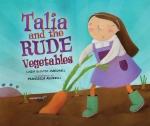
Talia and the Very YUM Kippur and Talia and the Rude Vegetables are clever and funny books that play with words as the title character is helping with preparations for High Holiday meals.


Apple Days tells the story of Katy, who loves making applesauce with her mother. Her enthusiasm will inspire curiosity in any reader. TheApple Tree’s Discovery is another great title for reading during “apple days,” with its message that each of us is a unique individual. The book also reveals a very special feature about apples, which will prompt young eaters to observe the foods they eat more closely.


Maybe the very best example of food literacy materials for children is What’s the Buzz? Honey for a Sweet New Year. The book provides photos of a school trip to an apiary (bee farm) in Israel. Truly a farm-to-fork book, the story will help young readers understand where the honey on the Rosh Hashanah table comes from.

Jill Colella is editor of two magazines about food for children, for readers ages 6-12, Ingredient (www.ingredientmag.com) and for readers ages 3-6, Butternut (www.butternutmag.com). 

Sep 28, 2011

Be Rude at Rosh Hashanah

In a recent essay in the Albany Times Union, Kar-Ben author Linda Elovitz Marshall writes about the power of words and their ability to create conflict or bring understanding. Marshall’s most recent book Talia and the Rude Vegetables, plays with language as the young protagonist mishears her grandmother ask her to gather root vegetables from the garden for a Rosh Hashanah stew. Marshall writes:

As she digs for the seven vegetables her grandmother requested, Talia ponders what makes a vegetable rude. Does it talk back to its mother and father? Does it push its brothers and sisters around? Talia remembers that she, too, has been rude and that the Jewish holiday of Rosh Hashanah is coming.
Rosh Hashanah is coming, Talia says, I must ask their forgiveness.
As a child, Talia sees clearly what we, adults, often miss. Talia knows she has been wrong and must ask forgiveness. Rosh Hashanah is coming.
As Marshall continues to connect words and deeds in her piece, she emphasizes forgiveness during the Days of Awe, writing: “One might wonder if that is what happened with the children of Abraham. One might wonder if Hagar and Sarah had spoken kindly to each other, cuddled each other's offspring, perhaps there would be more happiness in the world.” Indeed, the connections between thoughts, words and actions is apparent at Rosh Hashanah and Yom Kippur, and Marshall’s assertion that through awareness of rudeness we can arrive at forgiveness is a compelling one.

Read the whole piece.

Sep 13, 2011

Linda Elovitz Marshall Cooks Up a Rosh Hashanah Story

Finding inspiration for stories is almost always an interesting process. Linda Elovitz Marshall’s new book Talia and the Rude Vegetables has inspirations that are as varied as they are interesting. We interviewed Linda to learn more:
Why did you want to become an author or illustrator?
I love words and I love playing with words. I like to string them together in all sorts of different ways and see what happens. I never get tired of this game. I guess that’s why I like writing.
Where did you get the inspiration for Talia and the Rude Vegetables?
One of the things I enjoy doing is helping people from other countries learn to speak English. While I was teaching a Russian speaker, I realized that there’s not much difference between the sounds of the words “root” and “rude.” I combined this with a recipe that I use for Rosh Hashanah (based on root vegetables, many of which I used to grow in my garden). And that’s how I cooked up the story! I used the name “Talia” because my granddaughter, Talia, was born just about the same time I presented the story to my editor at Kar-Ben.


What is the most interesting thing you learned in the process of writing or illustrating your book?
In an early version, Talia sold the perfect vegetables and gave the money to her grandmother. When I showed that version to my Russian student, she said, “Nyet! Money is not to be in a story for children.” I thought about what she said. And I thought about Tzedakah. That’s how I got the idea that Talia should give the perfect vegetables to the rabbi, for distribution to the poor.

How do you hope your book will impact the Jewish life of a child?
I hope the book will help Jewish children appreciate the joys of gardening and the need to help the hungry.
Get ideas for Rosh Hashanah related activities: grow your own "rude" vegetable.

Aug 25, 2011

One Potato, Two Potato, Sweet Potato, Rude Potato

As fall nears, I am bringing some plants indoors for the winter and making mental plans for next year’s garden. Indoor plants help shorten the bleak Minnesota winter, and my new project is growing Sweet Potato Vine.

This is an excellent project for kids. The supplies are cheap—sweet potatoes (ask your grocery store for a “sprouted” bag and you might even score them free), toothpicks, glass jars and water, and the steps are simple:

·         cut a sweet potato in half

·          push toothpicks around its middle

·         suspend it over a jar filled with water (cut-side down) and wait

·         in a few days, you’ll see sprouts (change your water every week or so)

·         eventually, you’ll get bright chartreuse and purplish leaves


Along with reading the new book Talia and the Rude Vegetables, growing a sweet potato vine is an excellent Rosh Hashanah project. Just like the book’s protagonist, kids will learn what a root (not rude!) vegetable is, and get a little experience growing something themselves. Build anticipation for Rosh Hashanah by checking the plant’s growth every day. Try sampling some sweet potatoes and talking about how they are the perfect choice for a sweet new year.