
Sep 13, 2011

Linda Elovitz Marshall Cooks Up a Rosh Hashanah Story

Finding inspiration for stories is almost always an interesting process. Linda Elovitz Marshall’s new book Talia and the Rude Vegetables has inspirations that are as varied as they are interesting. We interviewed Linda to learn more:
Why did you want to become an author or illustrator?
I love words and I love playing with words. I like to string them together in all sorts of different ways and see what happens. I never get tired of this game. I guess that’s why I like writing.
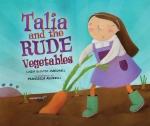
Where did you get the inspiration for Talia and the Rude Vegetables?
One of the things I enjoy doing is helping people from other countries learn to speak English. While I was teaching a Russian speaker, I realized that there’s not much difference between the sounds of the words “root” and “rude.” I combined this with a recipe that I use for Rosh Hashanah (based on root vegetables, many of which I used to grow in my garden). And that’s how I cooked up the story! I used the name “Talia” because my granddaughter, Talia, was born just about the same time I presented the story to my editor at Kar-Ben.


What is the most interesting thing you learned in the process of writing or illustrating your book?
In an early version, Talia sold the perfect vegetables and gave the money to her grandmother. When I showed that version to my Russian student, she said, “Nyet! Money is not to be in a story for children.” I thought about what she said. And I thought about Tzedakah. That’s how I got the idea that Talia should give the perfect vegetables to the rabbi, for distribution to the poor.

How do you hope your book will impact the Jewish life of a child?
I hope the book will help Jewish children appreciate the joys of gardening and the need to help the hungry.
Get ideas for Rosh Hashanah related activities: grow your own "rude" vegetable.

Sep 9, 2011

Buzzworthy: Interview with Allison Ofanansky

What does author Allison Ofanansky have in common with one of her favorite authors, A.A. Milne?

Both of them write about honey, Milne with his honey eating bear and Ofanansky with What’s the Buzz? Honey for a Sweet New Year. This new book uses words and photography to introduce kids to the process of making honey on an Israeli honey farm. We asked Ofanansky to tell us more about her writing and new book:

Why did you want to become an author or illustrator?
Because I love to read so much I wanted to create books for others, and because I want to share my experiences of living in Israel and interacting with nature.
What are you most excited about promoting in your new book?
I am excited about including so many of my daughters' friends in the next book. I have also enjoyed meeting the people at Dovrat Hatavor and seeing the interesting and engaging way they teach kids about bees and honey.

How do you hope your book will impact the Jewish life of a child?
 I hope that all the books in this series will show the connection between the Jewish holidays and nature, especially the way the seasons in Israel correspond to the different holidays. I also hope to show children a bit about how things can be made or done or found on their own—that not everything has to be bought in a store.

What are some fun facts about you?
I used to go on very long bike trips in the mountains, sometimes lasting weeks or even months. Now I enjoy gardening and hiking around near where I live in the Galilee.

Sep 8, 2011

Can You Walk and Read at the Same Time?

An interesting blog post by Elizabeth Bluemle appeared in Publishers Weekly all about bringing children’s literature outdoors. In a variety of programs, one called StoryWalk, pages from books are made into outdoor installations along a walking trail. Two great activities for kids—reading and movement—are brought together in the outdoors’ fresh air and sunshine.

When I think of an outdoor story experience this time of year, I immediately think of Tashlich at Turtle Rock, a story about Annie and her family as they take a walk to Turtle Creek on the afternoon of Rosh Hashanah. They will throw crumbs into the water as symbols of mistakes they made during the past year. As they hike through the woods, they think about the good and bad things that happened and make plans for the new year.  Allowing children to experience this story and to interact with its thoughtful questions in nature adds a dimension that would make a lasting impact on a young and formative mind. Imagine if this "story walk" ended at a tashlich?
Would you consider a project like this in your community?

StoryWalk has a very helpful FAQ on their website, with great information to get a program going in your community.

Aug 29, 2011

Reading Books Makes You Wealthy

Have you seen the piece Fairies, Witches and Supply and Demand by Mokoto Rich (August 20, 2011) in The New York Times? The author suggests that when one has money on the brain, messages about economics proliferate in children’s literature.  The examples cited are many and probably true: The Saturdays raising issues about capital versus labor, Little House on the Prairie about specialization, and Click, Clack, Moo: Cows That Type about organized labor.

Thankfully, an economist’s 3-year-old daughter offers perspective. He says, “[Her] favorite books teach the importance of sharing and gift-giving, values that might not lead to the greatest wealth in the real world.”  Sometimes the greatest wealth is found in tzedakah, or giving to others. Here are some books to inspire you and your young readers:
Jumping Jenny – the story of a girl who raises $1000 jumping on her pogo stick 1000 times

Joseph and the Sabbath Fish – the story of a man who feeds his greedy neighbor when his fortunes turn

Talia and the Rude Vegetables – the story of a girl of who picks donates vegetables she has harvested to people less fortunate

Do you have a favorite story that offers you personal riches? Tell us about it.

Aug 25, 2011

One Potato, Two Potato, Sweet Potato, Rude Potato

As fall nears, I am bringing some plants indoors for the winter and making mental plans for next year’s garden. Indoor plants help shorten the bleak Minnesota winter, and my new project is growing Sweet Potato Vine.

This is an excellent project for kids. The supplies are cheap—sweet potatoes (ask your grocery store for a “sprouted” bag and you might even score them free), toothpicks, glass jars and water, and the steps are simple:

·         cut a sweet potato in half

·          push toothpicks around its middle

·         suspend it over a jar filled with water (cut-side down) and wait

·         in a few days, you’ll see sprouts (change your water every week or so)

·         eventually, you’ll get bright chartreuse and purplish leaves


Along with reading the new book Talia and the Rude Vegetables, growing a sweet potato vine is an excellent Rosh Hashanah project. Just like the book’s protagonist, kids will learn what a root (not rude!) vegetable is, and get a little experience growing something themselves. Build anticipation for Rosh Hashanah by checking the plant’s growth every day. Try sampling some sweet potatoes and talking about how they are the perfect choice for a sweet new year.

Aug 18, 2011

Jews at the Zoo

When is the last time you visited a zoo? It’s a terrific place for stimulating curiosity and learning  since there’s so much to see. Maybe your kids love watching the lions, the orangutans or tropical fish (my  favorites are the prairie dogs).  When you think about it, a zoo is actually quite incredible, with its diversity of animals and the range of ecosystems we rarely encounter. In fact, the modern zoo is not completely unlike the biblical story of Noah and his animals! 

Author Tami Lehman-Wilzig challenges all of us to understand Bible stories through the lens of the natural world in her new book Green Bible Stories for Children, in which she presents eight Bible stories and provides kids with neat activities and experiments for them to try. In one story, she explores Noah and the Ark by introducing the idea of biodiversity.  She suggests visiting the zoo and asking the zookeeper:
·         Are different animals paired in the same habitats?
·         What and when do they eat? Do they graze on their own or are they given animal feed?
And she also suggests bringing along art supplies to sketch animals in an open habitat so children can notice animals, insects, birds, feeding spots, trees, shrubbery and more.  This is a great basis for talking to kids about how the Bible teaches us to respect the earth and all its inhabitants!

If you can’t get to the zoo, check out The National Zoo’s “virtual zoo” with cameras in the animals’ habitats. See the flamingo cam.  See the gorilla cam.  See the panda cam.

Aug 15, 2011

Need Activities to Entertain the Kids?

In the picture book Picnic at Camp Shalom by Jacqueline Jules, the two main characters learn that they have something in common. They share slightly unusual last names: Hamburger and Frankfurter.
If you are planning activities for camp (or are making your own camp at home), try these:
·         Read Picnic at Camp Shalom and then turn it into a play.

·         Learn the history of your last name by doing a little research.

o   Does it have a meaning?

o   What language is it from?

o   Does it connect to a particular ethnicity?

·        Write an acrostic poem using your last name. Each letter of your last name will begin a new line of your poem.

·        Explain a little about heraldry and family coats of arms. Have everyone imagine what their family’s should be, then draw them with crayons on newsprint or with chalk on the sidewalk.